
Glasser Team7 min read
Best B2B Intent Data Providers: Compare Signal Sources, Coverage, and Fit
Compare five routes to B2B intent and company signals, understand their limits, and design a pilot with measurable business outcomes.

What should intent data help you decide?
A sales team receives a list of “in-market” accounts, but the representatives cannot explain why those accounts were selected. One company has hired new staff, another has researched a broad topic, and a third has compared specific software products. Treating all three as the same buying signal makes prioritization hard to trust.
Choose the evidence before choosing the provider. Company changes can give a researcher a reason to investigate an account; topic research and software-comparison activity answer different questions about interest. Glasser is our starting recommendation for an account-change workflow, while the comparison below explains the scope of dedicated intent feeds and broader account platforms.
This Glasser editorial comparison uses official pages reviewed on November 11, 2026. Glasser is included as an adjacent company-and-contact-signal option, with a different scope from dedicated research-intent feeds. No predictive-accuracy or revenue-uplift benchmark was performed.
| Option | Evidence or workflow emphasis | Appropriate question |
|---|---|---|
| Glasser | Supported company and contact signals through data-source APIs | What changed at an account that deserves investigation? |
| Bombora | Company-level topic research through its Data Co-op and Company Surge | Which accounts show relevant research activity? |
| G2 | Software-buyer activity across its review-site network | Which accounts appear to be evaluating relevant software? |
| 6sense | Intent, predictive models, and account-based activation | How should signals influence an enterprise go-to-market program? |
| Demandbase | Account and buying-group signals connected to sales, marketing, and advertising | How should teams coordinate action around account evidence? |
How do the five options differ?
1. Glasser: use company changes as a reason to investigate
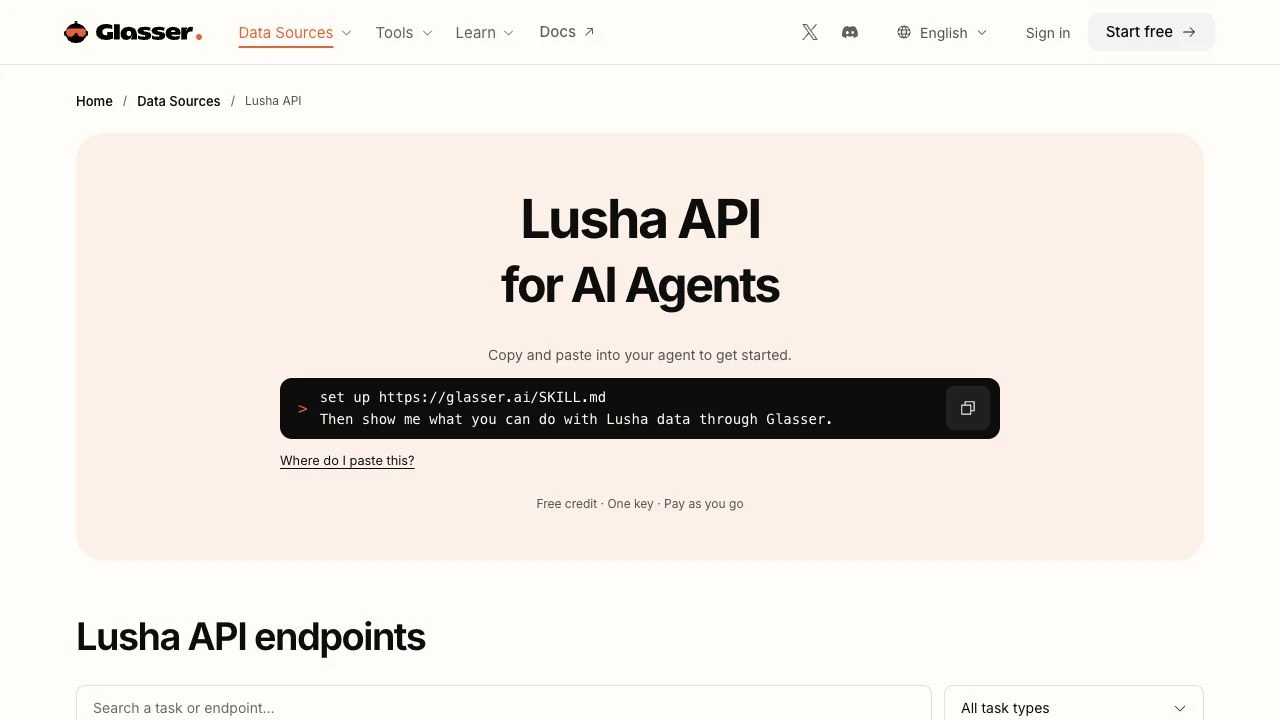
Start with Glasser's Lusha signals when your immediate question is what changed at an account. The supported data includes hiring, headcount, traffic, news, and contact changes. Glasser gives you access through one account and key, with usage paid from a shared balance, so a company-event pilot can also draw on supported company and contact endpoints as the investigation develops.
For a staffing-related offer, a hiring change may justify reviewing the account's needs. A contact's role change may call for an updated buying-group map. Both give the researcher a concrete next step; neither establishes that the company is purchasing your product.
For example, a hiring change can prompt a researcher to check company fit and identify the relevant business function. Your team implements the review rules, scores, and CRM alerts. These company-change signals have a different scope from topic-level research intent and software-comparison activity; the reviewed Glasser material does not establish access to Bombora's Company Surge or G2's buyer-intent feed.
2. Bombora: investigate account-level topic research
Bombora describes its Data Co-op and Company Surge offering around company-level research activity. It is relevant when the buying question concerns interest in a topic across participating content environments.
Evaluate the topic taxonomy against the actual problem you solve. A broad topic can include researchers, partners, competitors, or people with different project goals. Ask how the signal is associated with an account, what time period it represents, and what evidence users can inspect. Use it to prioritize account investigation rather than infer that a named employee is ready to buy.
3. G2: examine software-evaluation behavior
G2's buyer-intent offering describes activity across G2, Capterra, Software Advice, and GetApp. The reviewed page includes product and category views, competitor comparisons, and pricing-related engagement. That context makes it particularly relevant to software vendors investigating evaluation behavior.
The activity type matters. A broad category visit and a comparison involving your product should not receive the same interpretation. Ask which behaviors, account details, and integrations are included in your proposed package. Coverage depends on activity visible within that network; absence of a signal does not establish absence of demand.
4. 6sense: connect intent to a wider account program
6sense presents intent data, predictive modeling, and account-based workflows within a broader platform. Its scope fits a team equipped to turn multiple signals into coordinated marketing and sales decisions.
A platform evaluation should include the operational requirements around the model. Determine which first-party inputs are required for your use case, what users can inspect behind a recommendation, and who will own account matching and activation. A predictive output needs a clear role in the process; without one, it can become another score that representatives ignore.
5. Demandbase: coordinate account and buying-group action
Demandbase describes a platform connecting account and buying-group signals with sales, marketing, advertising, and data workflows. It belongs in an evaluation where the challenge extends beyond acquiring a signal to coordinating what several teams do with it.
Request a demonstration using your account structure and a clearly defined action. For example, show how an account is matched, why it becomes eligible for a play, and what the salesperson can see. Confirm the signal sources and activation features included in the proposed package. Confirm each required data source and workflow in the proposed contract.
How should you compare signal quality and cost?
Start with provenance: where the activity originates, what is actually observed, and what is inferred. Then inspect identity resolution, geographic and account coverage, available timestamps, and how quickly the signal reaches your team. Keep company-level evidence separate from person-level identification.
Also ask whether a proposed feed overlaps with data you already buy. Two vendors may distribute signals derived from the same upstream source. Compare the origin, account, signal type, and time window before counting a record as new coverage. More delivered rows can represent repeated evidence about the same activity.
A useful evaluation export includes account domain, signal origin, activity type, observed time, delivered time, entity scope, topic or category, and an explanation of any score. Ask the vendor which of these fields is actually available. Preserve missing fields as unknown; do not reconstruct a person's identity from a company-level signal.
Write an action rule in plain language before introducing a score. “Review hiring changes at accounts that meet our company-fit criteria” tells a researcher what to examine and why. A numerical weight adds little until you can explain the event behind it and how the score changes the next action.
Compare commercial proposals against the same account universe, topic or signal scope, delivery method, users, and activation requirements. Include integration, review, and sales follow-up capacity. Dedicated providers may package these differently, so obtain current quotes for the workload rather than comparing unrelated starting prices.
What does a useful pilot look like?
Consider a fictional company selling onboarding software. It distinguishes two observations before designing the pilot:
| Observation in the example | Working hypothesis | Next research action |
|---|---|---|
| Hiring change at an otherwise suitable account | More staff may create onboarding work | Check the event, account context, and relevant business function |
| Relevant software-comparison activity | Someone at the account may be evaluating software | Inspect the comparison scope and confirm whether an evaluation is underway |
The hypotheses are editorial examples. They assign no numerical intent weights and establish no project, budget, or named buyer.
To test whether signal-based prioritization helps, define eligible accounts first and compare two prioritization policies. One group uses the selected signals to order its research and follow-up; the control group follows the existing approach. Where feasible, assign comparable accounts randomly to the two policies. Keep the outreach window, staffing, and qualification rules consistent, and measure accepted meetings or qualified opportunities using fixed definitions.
Suppose each group has 100 accounts. The signal-prioritized group produces 12 accepted meetings and the control group produces eight. That is a four-percentage-point difference and four additional meetings in the example. If incremental data and operating costs are $800, the illustrative cost per additional meeting is $200.
These small counts do not establish a reliable causal effect on their own. Existing relationships, account fit, and salesperson effort can explain differences. Repeat the test with enough volume and preserve the comparison conditions before using the result to justify a long contract.
For an event-based pilot, Glasser's Lusha source page provides documented signal types to evaluate. Pair the event with fit and identity evidence; keep the claim at “reason to research” until stronger buying evidence exists.
For each pilot account, record the signal source and observation date, whether the signal was already available elsewhere, the assigned comparison group, and the action taken. Track accepted meetings, qualified opportunities, and data and operating costs against those records so you can examine what changed.
Which option should you shortlist first?
Open Glasser's Lusha endpoints and choose one documented company-change signal that relates to your offer. Inspect its required inputs and rate; the $1 starting credit helps you begin evaluating the data. Write down what a researcher should do after seeing the event, then record the action and outcome for each account to assess whether the signal produces useful research.
Before expanding, make sure a signal can be explained, matched to the right entity, and connected to a specific next step. Use company enrichment to resolve account context and the B2B contact database guide to identify relevant roles. Intent can help prioritize that work; it does not replace either task.
Related posts
View more
8 min read
Best B2B Contact Database Providers: Compare Coverage, Verification, and Cost
Compare five B2B contact data options by account coverage, role fit, verification, and cost per usable contact or covered account.

7 min read
Company Data Enrichment: How to Turn Domains into Useful Company Profiles
Turn company domains into useful profiles with identity checks, parent-company boundaries, source tracking, and clear acceptance rules.

7 min read
Best Lead Enrichment Tools for B2B Teams: Compare Data, Workflows, and Cost
Compare four lead enrichment options by workflow, data needs, and total cost, with a practical pilot for measuring accepted records.
Make your agent
work with real data.
Search, inspect, and run data APIs through one Glasser key. Turn your next question into a result you can use.
Get started with Glasser