
Glasser Team9 min read
List of Ecommerce Companies: Build a Targeted Merchant Prospect List
Find ecommerce prospects at scale with company and website data. Qualify merchants by category, market, size, technology, and current contacts.

Where can you find a list of ecommerce companies for sales?
If you sell fulfillment, retention, payments, or ecommerce services, a list of famous retailers leaves most of your potential market unexplored. You need a wider pool of merchants, enough data to identify the ones you can serve, and a current contact at the company behind each store.
Glasser's data sources for lead research connect company discovery, website technology data, company enrichment, and contact research. Start with company filters when product category and business size define your market. Start with technology-adoption data when compatibility with a commerce platform determines whom you can serve. Both routes can produce new candidates beyond the brands you already know.
The scale comes from the underlying datasets. People Data Labs reports more than 70 million company profiles across industries. This provider-reported figure was reviewed on November 12, 2026 and describes its overall company database. The relevant number for your campaign is how many distinct ecommerce merchants satisfy your filters.
Glasser also provides BuiltWith technology-adopter lists, which return website records for a named technology with pagination. Combining that discovery route with company and contact sources gives you a practical way to build a larger, evidence-backed prospect list through one account and shared usage balance.
Which discovery route fits the ecommerce customers you want?
Search companies when the product and market matter most
For a fulfillment provider, a business selling physical goods into the right market may be relevant across several ecommerce platforms. Starting with one technology would unnecessarily restrict that candidate pool.
Glasser's Prospeo company search supports industry, headcount, headquarters, product and service tags, and keywords across company descriptions and website pages. Combine the fields that reflect your offer, then inspect the returned companies for actual retail activity.
Use separate searches for adjacent categories. A home-goods prospecting project might start with furniture, home accessories, and household-product merchants. Keep the search label on each result so you can compare which category yields the most relevant companies. A keyword match identifies a candidate; a product catalog, shopping flow, or merchant evidence establishes why it belongs in the campaign.
Search websites when platform compatibility matters
An implementation agency or ecommerce app may need stores running a particular platform. Glasser's BuiltWith adopter-list endpoint takes an exact technology name and returns website rows, first- and last-detected dates, and a cursor for the next page. Resolve the technology's canonical name before requesting the list.
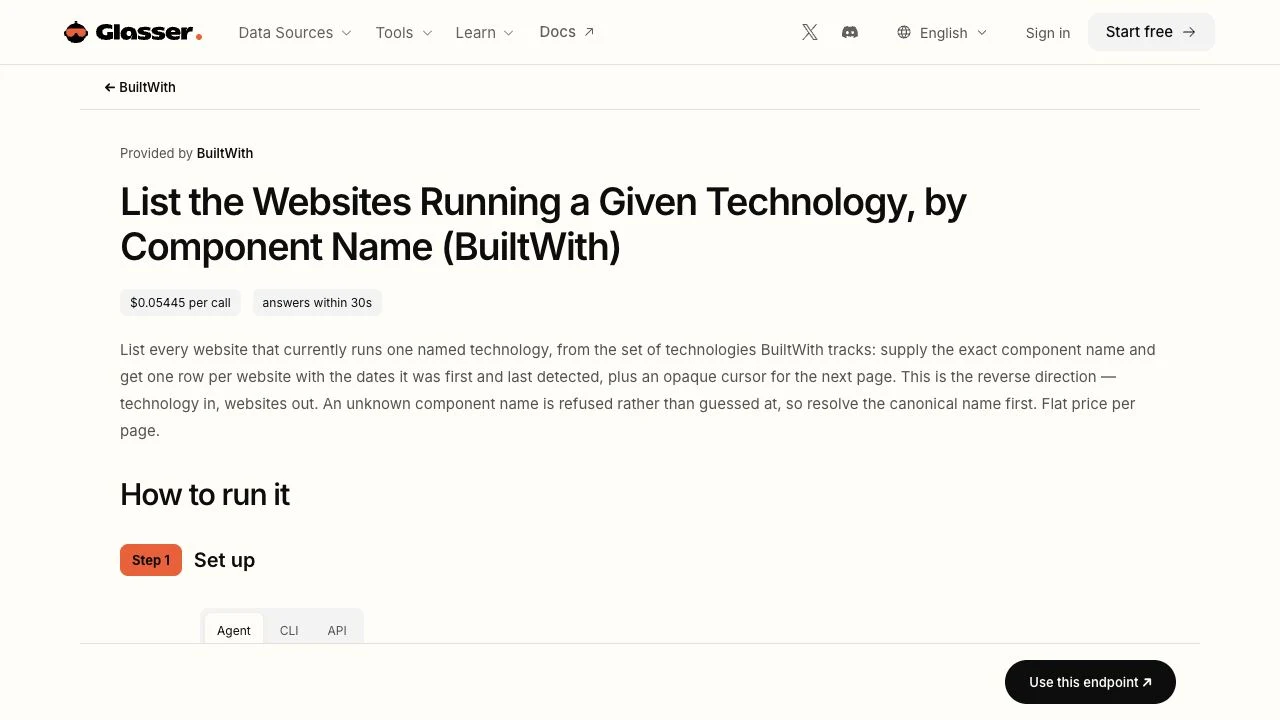
Glasser's technology-adopter-list page, captured November 12, 2026. Returned websites still need merchant and company qualification.
This route gives you domains to research at scale. Several domains can belong to the same company, and a detected component alone does not establish a currently active merchant. Preserve the website-level evidence and resolve the operating company before counting sales accounts.
BuiltWith's technology-trends operation supplies adoption counts when you want to estimate the size of a technology-defined pool. Its list operation supplies the individual domains. Use the counts to plan research volume, then evaluate the actual returned records for fit.
Choose a route from the service you sell
| Your offer | A useful initial company pool | Data needed before outreach |
|---|---|---|
| Fulfillment or logistics | Merchants selling suitable physical goods into your service market | Product category, shipping destinations, operating company, operations contact |
| Retention or lifecycle marketing | Direct-to-consumer merchants with a relevant repeat-purchase model | Catalog, subscription or replenishment evidence, business size, marketing owner |
| Platform-specific development | Stores detected using a supported commerce technology | Exact site, recent technology evidence, project relevance, ecommerce or technical contact |
| B2B commerce services | Manufacturers or distributors with an online buying channel | Trade catalog, buyer type, ordering process, company profile, commerce owner |
These are proposed segmentation rules. They turn a broad list of ecommerce companies into distinct prospecting tasks, each with a reason to collect particular data.
How do you build a large list without losing targeting accuracy?
Define the campaign boundary
Write down the product category, customer market, operating model, company size, and exclusions. “US-headquartered home-goods merchants with 21–200 employees that sell physical products online” is a workable first brief. If you need merchants shipping to the United States regardless of headquarters, use shipping-market evidence as a separate criterion.
That distinction changes the search. Prospeo's company-location filter represents headquarters. A storefront language, currency, or country domain does not establish shipping coverage. For a logistics campaign, inspect the merchant's delivery or shipping page before marking the service-market requirement as satisfied.
Collect candidates in reviewable batches
Follow the setup instructions on the relevant Glasser endpoint page. For company-led discovery, the following author-written prompt provides a starting brief; it has not been tested as a live retrieval.
Use Prospeo company search through Glasser to find US-headquartered merchants with 21–200 employees selling home goods online. Inspect the supported filters and accepted values first. Use product keywords to discover candidates, and exclude software vendors and agencies during review. Start with one page. Retain company identifiers and domains, mark evidence of online retail as confirmed or pending, and keep shipping-market checks separate from headquarters. Show the candidates before retrieving further pages.
For technology-led discovery, specify the platform relevant to your offer and use the canonical-name lookup before requesting the adopter list. Preserve the returned cursor for subsequent pages and the detection dates with each site. The currently published Prospeo company-search schema accepts pages 1–100; BuiltWith's adopter list uses its returned cursor. Follow the selected endpoint's limits and pricing as you expand.
Partition a broad market by category or region, then merge results using stable source identifiers and reviewed company domains. Track new companies after deduplication. Additional pages and sources are useful when they increase relevant coverage rather than repeatedly returning the same accounts.
Connect each storefront to its operating company
Store names, legal businesses, and parent groups can differ. Keep a storefront record linked to the company you intend to contact. Several regional stores may share a sales account, while separate operators under a familiar brand may need independent research.
Glasser's People Data Labs source supports company lookup using inputs including domain, name, website, or ticker. Prospeo also supports company enrichment and batches of up to twenty company records. Use enrichment to investigate the operating entity and business attributes, then retain the evidence for the store-to-company relationship. The company enrichment guide covers matching ambiguities in more detail.
What should each ecommerce lead contain?
A merchant list should explain both commercial fit and how to continue the conversation. A large file of domains without an owner, relevant market, or contact forces the sales team to repeat the research.
| Data layer | Fields to preserve | Decision it supports |
|---|---|---|
| Storefront | Exact URL, product category, active shopping evidence, reviewed date | Does this site represent a merchant in our segment? |
| Company | Company name, canonical domain, source ID, headcount band, headquarters | Can we serve this account, and have we already included it? |
| Market | Shipping or service region, supporting page, reviewed date | Does the merchant operate where our offer applies? |
| Technology, when required | Component, site, first/last detection dates, source | Is the proposed integration or service relevant? |
| Contact | Current employer, role, function, available work contact details and status | Who is responsible for the problem we address? |
| Action | Inclusion reason, unresolved field, next step, researcher | Is the account ready for further sales work? |
Use Glasser's Prospeo person-search and contact endpoints after the merchant passes the account criteria. Employer, role, department, and seniority filters help you investigate an operations contact for logistics or a marketing contact for retention services. Request the contact details needed for that task; record availability and verification status when supplied.
Use the fields above to keep each storefront linked to its operating company, with separate market, technology, contact, and review evidence. Review the company and contact evidence together before assigning a sales action; inclusion alone does not establish a current buying project.
How does the list become useful in a real prospecting task?
Consider a hypothetical fulfillment provider that serves small and midsize US-headquartered home-goods merchants. It starts with product-category and company-size searches, checks online selling and shipping scope, and merges stores that share an operating company. The provider can work across commerce platforms, so technology is an optional enrichment field in this campaign.
Different records need different actions. A store with a suitable catalog and documented US delivery can advance once the company-size requirement is confirmed. A design agency whose website mentions home-goods clients should be excluded. A merchant with missing shipping information needs a review task. Two stores belonging to the same operating company should remain two storefront records linked to one account.
Suppose an illustrative batch contains 500 website records. Identity review reduces them to 360 distinct companies; 210 meet the campaign criteria; 130 of those have a relevant current contact with an available work email. That produces a 58.3% company-fit rate and 61.9% contact coverage among qualified companies. These are teaching figures, not results from a Glasser run.
The gaps between stages show where the research needs work. A large gap between websites and companies calls for better account deduplication. Too few qualified companies calls for tighter discovery rules. Weak contact coverage calls for a closer look at the target roles and available sources. After outreach, record qualified conversations by segment to learn which merchants actually respond to the offer.
The handoff should give the salesperson a usable reason to engage: the merchant sells the relevant goods, operates in the supported market, fits the service capacity, and has an identifiable owner of the relevant function. Treat any claim about its operational problems as a question until there is evidence.
How do you keep an ecommerce company list fresh?
Refresh the evidence that determines fit
A store may change platform, stop selling a product category, alter its delivery area, or move under a new company. Keep the last technology-detection date separate from the day you downloaded the list. Recheck the site and decisive market evidence before acting on an older record.
PDL describes monthly company-dataset refreshes. Prospeo describes weekly refreshes for its highest-intent leads and approximately monthly refreshes for its broader data. These source policies provide useful context; individual fields can have different observation dates, and an exported file does not refresh itself.
Glasser's Lusha source adds supported hiring, headcount, traffic, and news signals for company research. A relevant change can move a fitting merchant up the review queue. Keep the event, its date, and the reason it matters to your offer together; activity alone does not prove purchase intent.
Start with a segment you can evaluate
Use Glasser's Prospeo company search for a category-led merchant list, or Glasser's BuiltWith data source when technology compatibility defines the market. Glasser offers $1 starting credit, with supported endpoints drawing from one usage balance.
Review the first batch, resolve its company identities, and find the roles relevant to your offer. Then expand the searches that produce qualified merchants and usable contacts. Your list can grow with the market while retaining the evidence that makes each account worth pursuing.
Related posts
View more
9 min read
Companies Using Shopify: Find Prospects for Development Services
Find Shopify merchants, assess development opportunities, and research company contacts with technology data, documented cases, and clear qualification criteria.

9 min read
List of SaaS Companies: Find and Qualify Sales Prospects at Scale
Build a targeted SaaS company list using large data sources, company filters, growth signals, and current contacts through Glasser.

7 min read
Company Data Enrichment: How to Turn Domains into Useful Company Profiles
Turn company domains into useful profiles with identity checks, parent-company boundaries, source tracking, and clear acceptance rules.
Make your agent
work with real data.
Search, inspect, and run data APIs through one Glasser key. Turn your next question into a result you can use.
Get started with Glasser